
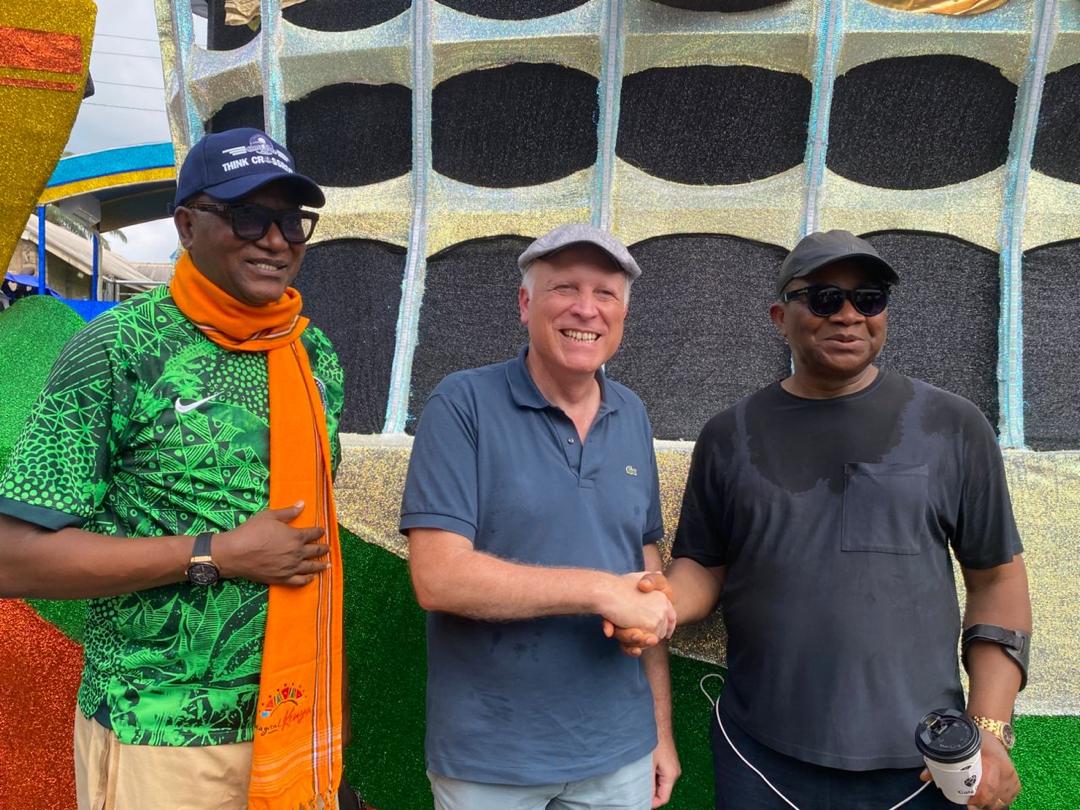
Portugal’s Ambassador to Nigeria, Paulo Martins Santos, has praised the quality and cultural depth of the Carnival Calabar, describing his first experience of the festival as impressive and full of potential for greater international recognition.
Speaking during his visit to Calabar, Santos said he was struck by the organisation and seriousness of the events, starting with the children’s festival, which he attended shortly after arriving in the state. Contrary to his expectations of a simple children-focused parade, the ambassador said the event reflected strong planning, symbolism and cultural intent, setting the tone for what he was told would be a series of even bigger spectacles, including the bikers’ parade and the main carnival procession.
Santos, who has lived in Nigeria for more than two years, said he experienced no cultural shock in Calabar, noting the long-standing historical ties between Portugal and Africa, including Nigeria. He explained that shared history and cultural exchanges over more than five centuries have created a familiarity that makes Portuguese visitors feel at home across the continent.

L-R: Organiser, Akwaaba African Travel Market, Ikechi Uko; Ifeanyichukwu Udom – General Manager South Region, MTN; Sir Gabe Onah, Executive Chairman, Cross River State Carnival Commission; Theo Nnabugwu, MTN; Chibuzor – Senior Manager, Network Operations, MTN and Akuchie – Manager, Sales and Trade Development, Cross Rivers Business Area at the 20th edition of Carnival Calabar.
On hospitality, the ambassador described his reception as exceptional, praising the warmth of his hosts and the opportunity to explore not just Calabar but also parts of neighbouring Akwa Ibom State. He noted that the coastal setting of Cross River was particularly appealing, given Portugal’s own maritime heritage.
Reflecting on the 20th edition of Carnival Calabar, Santos said the festival was still relatively young compared to some of the world’s most famous carnivals but had clear potential to grow into a globally recognised cultural brand. He recommended a more deliberate international marketing strategy, especially in Europe, where awareness of the Calabar carnival remains low compared to events in Brazil and the Caribbean.
Drawing parallels with Portugal’s own carnival traditions, Santos explained that carnival celebrations in Portugal date back over 2,000 years to the Roman Empire and were later exported to Brazil during Portuguese colonial rule. He said preserving and showcasing symbolic carnival structures in museums, as done in Portugal, could also help strengthen the historical and cultural legacy of Carnival Calabar.
Beyond the festival, the ambassador highlighted Nigeria’s cultural diversity as its greatest tourism asset, describing the country as anything but monolithic. According to him, the wide range of ethnicities, languages and traditions across Nigeria’s states creates a rich cultural palette that can appeal strongly to international visitors.
Santos also revealed a personal fondness for Nigerian cuisine, naming jollof rice as his favourite dish, and said he would encourage members of the Portuguese community in Nigeria to attend future editions of Carnival Calabar.


