
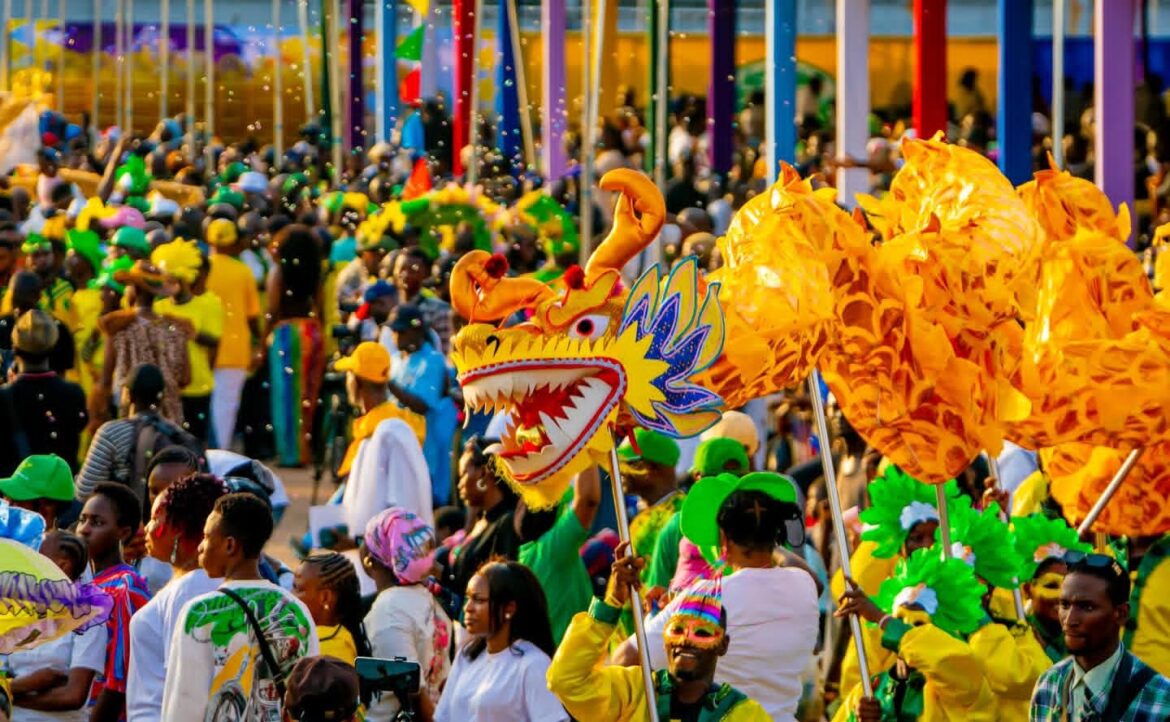
By mid-morning on Easter Monday, the energy around Tafawa Balewa Square had already begun to shift. What started as a gathering slowly unfolded into something far more immersive, a full-bodied cultural experience that pulled you in, step by step, until you were no longer just watching the Lagos Fanti Carnival, but living inside it.
From the vantage point of the crowd, the 2026 edition felt less like a scheduled event and more like a moving story, one that began in the narrow streets of Lagos Island and found its climax in the heart of the square. You could hear it before you saw it: drums layering over distant chants, whistles cutting through the air, and that unmistakable hum of anticipation.
Then came the processions.
Groups from historic communities Campos, Lafiaji, Okoo-Faji, Okepopo, and Isale-Eko—did not just arrive; they announced themselves. Each entry felt like a statement. The streets feeding into the square became living corridors of culture, as performers, dancers, and horsemen moved with purpose, drawing cheers from onlookers who lined every available space.
What made this year even more striking was the diversity of faces in the crowd. Foreign visitors stood shoulder-to-shoulder with Lagosians, cameras in hand, soaking in the spectacle. Among the notable guests in attendance were key stakeholders in Nigeria’s tourism space, including the Nigeria Association of Tour Operators, led by its president, Bolaji Mustapha, alongside Amb. Ikechi Uko, the convener of the Akwaaba African Travel Market. Their presence underscored what was already evident from the ground the carnival is no longer just a cultural gathering; it is fast becoming a strategic tourism platform, turning historic communities into a thriving hub of cultural exchange and economic activity.

Standing among the crowd, what struck you first was the detail. Costumes shimmered under the sun—gold catching the light, deep reds and royal blues creating a striking contrast. Feathers swayed, beads glistened, and towering headpieces commanded attention with quiet authority. It was not just fashion; it was storytelling. Every stitch seemed to carry echoes of history, the legacy of the Afro-Brazilian returnees, the Aguda, whose influence still shapes the identity of Lagos Island today.
Inside the main arena, the experience deepened. Seating arrangements stretched from general access to VVIP enclosures, marked by layers of color-coded tags and careful demarcations. Yet, despite the structure, the spirit of the carnival remained shared. Whether seated in the stands or standing shoulder-to-shoulder in the open areas, everyone was connected by the same rhythm.
When Babajide Sanwo-Olu arrived, the shift was immediate. The crowd surged not in chaos, but in recognition. Phones went up, cheers followed, and for a moment, the spectacle on the ground met the symbolism of leadership in one frame. It felt cinematic, but also deeply local, a reminder that this was Lagos telling its own story.
Performance after performance unfolded without pause. The Lafiaji Fancy Team, Okepopo Fancy Team, Epetedo Fancy Team, Brazilian Campos Fancy Team, Okoo-Faji Fancy Team, Olowogbowo Fancy Team, and Isale-Eko Fancy Team each brought something distinct. Children led many of the parades with confidence that belied their age, while horsemen cut through the formations with a regal presence. Beauty pageants glided past in ornate palanquins, drawing admiration from every corner.
Among them, the Olowogbowo Fancy Carnival Team stood out not just for their choreography, but for their message. Their performance carried a quiet sense of purpose, blending artistry with a call for unity and civic responsibility. It was entertainment, yes, but also expression. From where you stood, you could feel that duality: celebration on the surface, meaning underneath.
Beyond the arena, the carnival spilled into commerce and community. Vendors called out to passersby, artisans displayed handcrafted pieces, and local businesses thrived in the movement of the crowd. It was a reminder that events like this do more than entertain; they sustain livelihoods.
For first-time attendees, especially younger ones, the experience felt almost like a discovery. You could overhear conversations, curiosity turning into pride. A student nearby summed it up simply: they came for the vibe, but left with a sense of belonging to something much older, much deeper.
Tourists, too, found themselves drawn in. There was a kind of awe in their reactions, not just at the colors or the music, but at the layered identity on display. The colonial-era architecture surrounding the square, with its Brazilian influences, quietly reinforced the story playing out in front of them. It was history, not in books, but in motion.
As evening approached, the tempo softened. The drums slowed, the crowd thinned slightly, and the golden light of sunset settled over the square. But even as the performances wound down, the feeling lingered.
Because from within the crowd, one thing became clear: the Lagos Fanti Carnival is not just something you attend, it is something you enter.
It is where history finds rhythm, where identity takes form, and where Lagos, in all its complexity and color, speaks for itself loud, proud, and unmistakably alive.


